
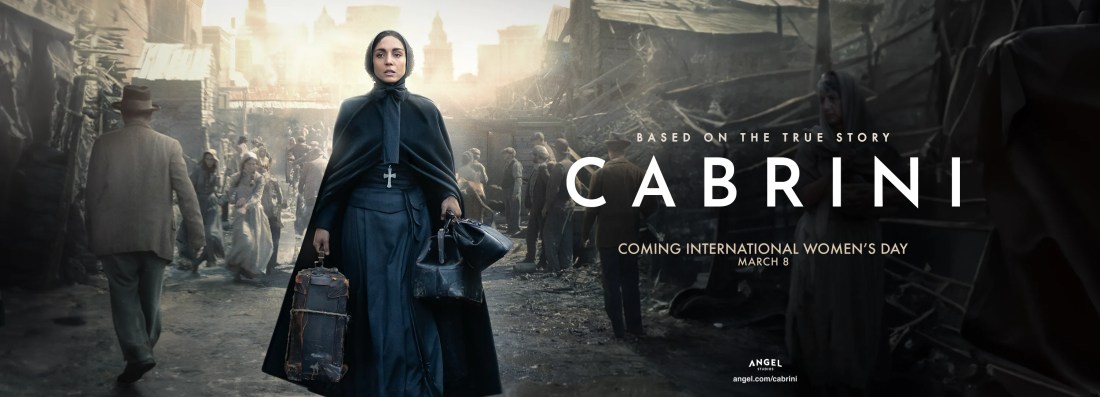
Happy Women’s History Month, everybody! The time of year when we band together to remember and celebrate all of the unique contributions women have made. To celebrate, I would like to bring your attention to an oft forgotten yet vital figure not only in women’s history, but Italian American and Catholic history. I am talking about none other than Saint Frances Xavier Cabrini, Mother Cabrini for short. As the title suggests, this post will cover my first impressions of the newly released movie. As well as what it means to me as both a cradle Catholic and a woman.
First, it is important to note that I was already familiar with Mother Cabrini. I first heard her story from the children’s podcast series Saints Alive. Learning about everything she had accomplished in the face of such hardships made me wish someone had told me about her earlier. So when I found out that a biographical movie based on the life of Mother Cabrini produced by Angel Studios was being released in theaters, I had quite a response.
The best word I can use to describe my initial response to the news is nervouscited (a combination of nervous and excited.) Part of me was nervous because religious media has a shoddy reputation. With very few exceptions, many modern pieces of entertainment meant to teach about religion or use religious themes tend to be polarizing, either deemed too preachy by secular audiences or too shallow by religious audiences. My next concern was regarding some of the emotional scenes depicted in the trailers. I was still carrying a heavy emotional burden from the most recent season of The Chosen, which I will explain in more depth in a separate post. I was afraid that the movie would trigger my hyperempathy and send me into an emotional meltdown.
Another side of me could hardly contain my excitement! After learning about Mother Cabrini, I thought about how many people had been kept in the dark about her story. After all, I hadn’t heard of her until I was an adult. In fact, there are very few mainstream movies about the saints and even fewer about women and girls who were saints. I thought If this movie turns out to be a success, it could open up a whole new realm of possibilities!
I didn’t have to wonder much longer as I finally got the chance to see it in theaters. Although I wasn’t fortunate enough to see its premier on International Women’s History Day, I was able to see it the following weekend. So now that I’ve seen it what do I think? I can summarize my thoughts in one word: Amazing! But I’m sure you want to know why I hold such a high opinion of this movie. So, I’ll provide a few more words to explain it.
Now, as I mentioned before I was born and baptized Catholic and I still practice my faith devoutly to this day. However, this does not mean that any movie featuring a Christian protagonist or exploring Christian themes gets an automatic pass from me. In fact, I have seen plenty of religious movies which come across as boring or preachy. Thankfully, Cabrini is neither.
Although the movie tackles very serious themes, it isn’t afraid to have some fun once in a while. One example which comes to my mind is the puppet show at the Italian American festival. This scene briefly emphasizes the discrimination and police brutality many Italian Americans faced at the time but in a humorous way. Humor can help grab people’s attention when they may otherwise turn a blind eye to a certain subject. It can also help people find relief in the face of those obstacles and diminish the power of people who use fear to overpower others.
Then there’s the scene where Mother Cabrini and her assistant are playfully throwing mud at each-other while standing in the well that was once thought to be completely dry. This scene, along with many others, depicted a woman who was able to find joy in even the smallest things in life and was not afraid to get her hands dirty. It also reminded me of the nuns who taught classes at my school when I was young. I admit I was so entranced by their holiness that I even became somewhat intimidated. I thought How can I measure up to that? Thankfully, this scene reinstated what I quickly learned after a few short days in class: it is possible to be both fun and holy.
As I stated previously, many faith-based movies haven’t been well-received by modern audiences. Some spend so much of the runtime preaching their theology that it never succeeds at telling a compelling story. Others try so hard to be marketable and appealing to a wider audience that the religion barely factors into the narrative. The people behind Cabrini were faced with a challenging task. They wanted a movie that could be shown to audiences in theaters across the united states, some of whom may not come from a Catholic background. At the same time, they couldn’t ignore the religious aspect since Cabrini herself was not only a missionary, but a nun as well.
In my opinion, they struck just the right balance between appealing to religious audiences while still being palatable for secular audiences. When I think of this movie, I recall this verse from the book of James “Even so faith, if it hath not works, is dead, being alone.” James 2:17
While we do see Mother Cabrini consulting with religious leaders and occasionally talking about God, these scenes don’t make up the majority of the runtime. Instead of preaching religious message to the audience, Cabrini gives them a chance to shine through the saint’s actions. When she opens her home in America to the orphaned, immigrant children, audiences are able to witness how much love God has even for the people rejected by others. When she eventually succeeds after encountering obstacle after obstacle, the audience is able to understand the importance of persisting in the face of setbacks. These moments contribute to the overall message of finding hope, which is something people need now more than ever.
Throughout her time in New York, Cabrini receives constant objections from both the priest and the archbishop. Although I haven’t seen much uproar over this aspect of the movie, I understand some people may be uncomfortable with how some of the members of the clergy are depicted. However, I personally did not have a problem with this. During my time in school, I learned about various Church scandals and I’ve heard about even more of them as an adult. After all, the leaders of the Church are only human and humans are capable of falling prey to the consequences of sin. Therefore, the actions of the priest and archbishop are a reflection of the systemic sexism and ethnic prejudice at the time rather than the Catholic Church as a whole.
In my opinion, Cabrini definitely succeeds from a religious angle. But how is it as a movie? Well, I must admit that I haven’t seen many biographical movies. However, watching this movie has made me want to check out some others. Like many movies in this genre, instead of following a linear plot about a character going from point A to point B, this movie features Mother Cabrini’s involvement in various events during her time in New York while facing a series of smaller conflicts with the main conflict lingering in the background until near the end of the movie. Although it certainly helps to know her story before going in, those who haven’t heard it will likely understand the simple plot of a woman wanting to serve the poor while fighting against poor health and prejudice.
Personally, I think Cabrini more than makes up for being light on plot with how it depicts its main character, which I’ll cover in more depth later, and its brilliant visuals. Nowhere is the latter more apparent than in the contrast between the bright color schemes in Italy and the duller, paler hues of the working class sections of New York.
It also succeeds in how it depicts the challenges faced by immigrants at the time. In the opening where we see a young boy pushing the body of a woman in a wheelbarrow through the bustling streets. When he finally reaches the hospital, his cries for help are brushed off and he is promptly tossed back out onto the street by the police. This is also evident in the scenes where onlookers laugh and hurl slurs at Mother Cabrini. Then there are the moments where she flocks to the archbishop seeking assistance only to be brushed off because she’s a woman, although he never admits this. These scenes depict prejudice without coming across as cartoony or gratuitous.
This movie also raises some thought-provoking questions about what immigrants went through back then and to this day. How many people knew the Italians were once such a marginalized group? How many immigrants today have had to hear similar slurs and insults? How many of them have been prohibited from receiving basic human resources because of the language barrier? How do they preserve their original cultures while trying to assimilate into a new, western culture? What is the Catholic Church doing to help these people? What more can be done to help them?
There’s just one improvement that I believe could have been made. In one scene, Cabrini mentions that she nearly drowned as a child. Flashbacks of her near-death experience are also dispersed throughout the movie. Personally, I would like to have seen more scenes from her childhood. Cabrini was born two months premature which not only explains her poor health, but also establishes her as a fighter from an early age. Also, like many of the saints, she discovered her calling as a missionary when she was just a girl. This would have given viewers some more insight into her character and what led her to her current circumstances.
Now that I have covered what this movie means to me as a practicing Catholic and a moviegoer, I want to discuss how it impacted me as a woman.
As stated previously, I first heard Mother Cabrini’s story through her Saints Alive episode. The episode opens with a young girl named Emma asking “Why do men get to do all of the important things?” I could definitely relate to this sentiment growing up. When I aged out of the all-girls autism social groups for kids and teens, I became one of only three or four women among the many men in the group. When the boy scout and girl scout troop leaders pitched their groups to my class, I learned that the boys could go camping and build marshmallow cannons while the girls could have sleepovers at the football field and drink soda. During my schooldays, the priests would often ask the boys in my class to help with special assignments before, during, after, or between Mass. Meanwhile, the nuns never asked me or any of the girls to assist them with anything.
Then I wondered how many girls could be having the same thought. How could they not when so many people only talk about the accomplishments of the men in the Bible and the male saints? Most religious pieces of media present girls and women solely as spectators on the sidelines of men’s lives. Meanwhile secular media tends to shun any traits typically associated with femineity by encouraging women to be completely independent. That’s why I’m so thankful for Cabrini.
While Mother Cabrini opted for a life as a missionary rather than a wife, she also chose to found an orphanage for the troubled, immigrant children in the community. This emphasizes two very important points. First, it demonstrates that declining married life and caring for children are both valid ways of expressing womanhood. Second, it reminds viewers that family is not limited to the people we are born to. We can choose to include the people in our lives who provide us with ongoing social and emotional support as part of our families. Even Mother Cabrini herself states this, which brings me to by next point.
Anyone who has read the Bible will likely recall the numerous stories of women who have been deemed “sinful” or “unclean.” From the story Samaritan woman at the well to the woman who washed Jesus’ feet with her tears, there are too many examples of self-proclaimed holy people turning their noses up at women they should be helping. Sadly, this isn’t an uncommon phenomenon today. Too often women and girls who say the wrong things or wear the wrong outfits are harshly punished without any consideration for their circumstances.
Mother Cabrini’s interactions with a young woman who works as a prostitute remind us how people like her should be treated. Instead of condemning her for her lifestyle, she takes her under her wing and tends to her wounds, both physical and metaphorical. This is exemplified in the scene after the young woman kills her attacker in self-defense. After lamenting about how broken and filthy she is, Mother Cabrini responds with something like “We cannot choose who we are born to. But God calls us to choose the path He is calling us towards.”
I think the reason why this movie resonated with me so deeply is because many parts of Mother Cabrini’s story remind me of my own. Throughout my adolescence I observed various displays of femineity both in the media and in the world around me. It seemed every other girl had a certain group or archetype that seemed to fit her perfectly. At my school alone there were the scholars, the athletes, the socialites and the artists among others. In the movies and on TV I saw girls like Black Widow, the super spy and great covert assassin with superhuman strength and agility. Then there’s Moana, a girl who braved the seas and held command over the god of the wind and sea even at the young age of sixteen.
I was nothing like these girls. I was the goody-two-shoes who rarely broke the rules. I was the last one to finish running laps in P.E class. I wore my heart on my sleeve and I wouldn’t hesitate to give it to those in need. However, I spent most of my school days sitting on the sidelines, waiting for someone else to make the first move towards friendship so I wouldn’t risk making a big mistake. I soon found myself asking Am I doing this whole “girl thing” right? Where do I fit in? How can I be strong? How can I measure up to this idea of a “strong, empowered woman?”
After seeing learning about the life of Mother Cabrini, I learned about a different kind of strength. A quieter, simpler, but equally valid sort of strength. Instead of combatting her problems with brute force or sharp-tongued comebacks, she attempts to meet her detractors at their level in an attempt to reach a compromise.
Nowhere is this more evident than the scene where she approaches a local journalist to write an exposé about the harsh lives of the immigrants. After being brushed off on so many occasions, one would hardly blame her if she lashed out at him. Instead she invited him to come with her to the immigrant neighborhoods, allowing reality to speak for itself. During my time in college, I allowed my professors and classmates to gain an understanding of the individual strengths and challenges of autistic women in a neurotypical-centered world through my essays and presentations. I created this blog in hopes of continuing this mission.
However, what I admire most about Mother Cabrini is her kind heart. Too often kindness is falsely conflated with weakness or foolishness. On the contrary, it takes a great deal of strength to stand up for people who are being treated badly or to speak out against injustice even when you’re the minority as Cabrini herself demonstrates. It takes even greater strength to open your heart and home to those in need. As someone who majored in social work, I can attest to this. I aim to follow in her footsteps by volunteering as a Teammates mentor for at-risk children.
It’s been said that well-behaved women don’t make history. Modern media often reflects this statement by solely focusing on women who are loud or physically strong. Cabrini offers a breath of fresh air by shedding some light on an ordinary woman who performed extraordinary acts of kindness. With the amount of praise this movie has received from moviegoers and critics, there’s a growing opportunity for more women in the Bible and the Catholic Church to have their stories told in theaters across the U.S, maybe even the world. Perhaps well-behaved women, like me, can and should make history.
 Life with Anne