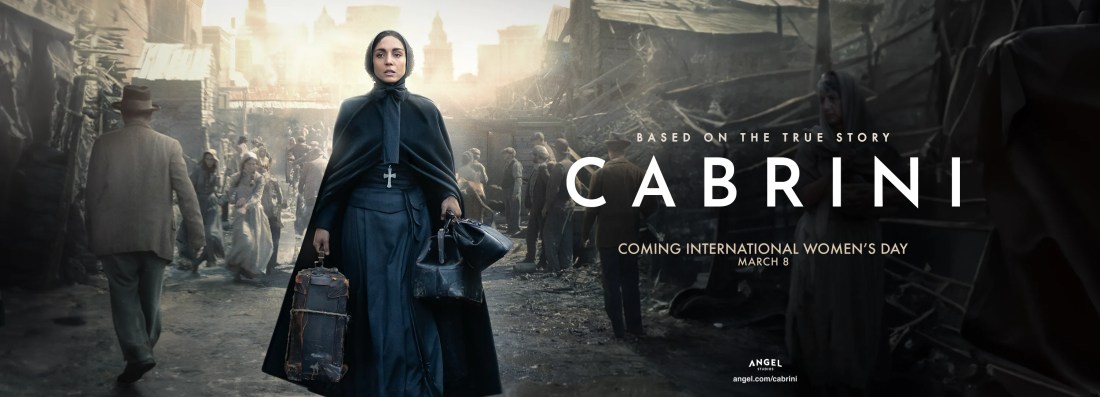
Cabrini: My First Impressions

Happy Women’s History Month, everybody! The time of year when we band together to remember and celebrate all of the unique contributions women have made. To celebrate, I would like to bring your attention to an oft forgotten yet vital figure not only in women’s history, but Italian American and Catholic history. I am talking about none other than Saint Frances Xavier Cabrini, Mother Cabrini for short. As the title suggests, this post will cover my first impressions of the newly released movie. As well as what it means to me as both a cradle Catholic and a woman.

First, it is important to note that I was already familiar with Mother Cabrini. I first heard her story from the children’s podcast series Saints Alive. Learning about everything she had accomplished in the face of such hardships made me wish someone had told me about her earlier. So when I found out that a biographical movie based on the life of Mother Cabrini produced by Angel Studios was being released in theaters, I had quite a response.

The best word I can use to describe my initial response to the news is nervouscited (a combination of nervous and excited.) Part of me was nervous because religious media has a shoddy reputation. With very few exceptions, many modern pieces of entertainment meant to teach about religion or use religious themes tend to be polarizing, either deemed too preachy by secular audiences or too shallow by religious audiences. My next concern was regarding some of the emotional scenes depicted in the trailers. I was still carrying a heavy emotional burden from the most recent season of The Chosen, which I will explain in more depth in a separate post. I was afraid that the movie would trigger my hyperempathy and send me into an emotional meltdown.

Another side of me could hardly contain my excitement! After learning about Mother Cabrini, I thought about how many people had been kept in the dark about her story. After all, I hadn’t heard of her until I was an adult. In fact, there are very few mainstream movies about the saints and even fewer about women and girls who were saints. I thought If this movie turns out to be a success, it could open up a whole new realm of possibilities!

I didn’t have to wonder much longer as I finally got the chance to see it in theaters. Although I wasn’t fortunate enough to see its premier on International Women’s History Day, I was able to see it the following weekend. So now that I’ve seen it what do I think? I can summarize my thoughts in one word: Amazing! But I’m sure you want to know why I hold such a high opinion of this movie. So, I’ll provide a few more words to explain it.

Now, as I mentioned before I was born and baptized Catholic and I still practice my faith devoutly to this day. However, this does not mean that any movie featuring a Christian protagonist or exploring Christian themes gets an automatic pass from me. In fact, I have seen plenty of religious movies which come across as boring or preachy. Thankfully, Cabrini is neither.

Although the movie tackles very serious themes, it isn’t afraid to have some fun once in a while. One example which comes to my mind is the puppet show at the Italian American festival. This scene briefly emphasizes the discrimination and police brutality many Italian Americans faced at the time but in a humorous way. Humor can help grab people’s attention when they may otherwise turn a blind eye to a certain subject. It can also help people find relief in the face of those obstacles and diminish the power of people who use fear to overpower others.

Then there’s the scene where Mother Cabrini and her assistant are playfully throwing mud at each-other while standing in the well that was once thought to be completely dry. This scene, along with many others, depicted a woman who was able to find joy in even the smallest things in life and was not afraid to get her hands dirty. It also reminded me of the nuns who taught classes at my school when I was young. I admit I was so entranced by their holiness that I even became somewhat intimidated. I thought How can I measure up to that? Thankfully, this scene reinstated what I quickly learned after a few short days in class: it is possible to be both fun and holy.

As I stated previously, many faith-based movies haven’t been well-received by modern audiences. Some spend so much of the runtime preaching their theology that it never succeeds at telling a compelling story. Others try so hard to be marketable and appealing to a wider audience that the religion barely factors into the narrative. The people behind Cabrini were faced with a challenging task. They wanted a movie that could be shown to audiences in theaters across the united states, some of whom may not come from a Catholic background. At the same time, they couldn’t ignore the religious aspect since Cabrini herself was not only a missionary, but a nun as well.

In my opinion, they struck just the right balance between appealing to religious audiences while still being palatable for secular audiences. When I think of this movie, I recall this verse from the book of James “Even so faith, if it hath not works, is dead, being alone.” James 2:17

While we do see Mother Cabrini consulting with religious leaders and occasionally talking about God, these scenes don’t make up the majority of the runtime. Instead of preaching religious message to the audience, Cabrini gives them a chance to shine through the saint’s actions. When she opens her home in America to the orphaned, immigrant children, audiences are able to witness how much love God has even for the people rejected by others. When she eventually succeeds after encountering obstacle after obstacle, the audience is able to understand the importance of persisting in the face of setbacks. These moments contribute to the overall message of finding hope, which is something people need now more than ever.

Throughout her time in New York, Cabrini receives constant objections from both the priest and the archbishop. Although I haven’t seen much uproar over this aspect of the movie, I understand some people may be uncomfortable with how some of the members of the clergy are depicted. However, I personally did not have a problem with this. During my time in school, I learned about various Church scandals and I’ve heard about even more of them as an adult. After all, the leaders of the Church are only human and humans are capable of falling prey to the consequences of sin. Therefore, the actions of the priest and archbishop are a reflection of the systemic sexism and ethnic prejudice at the time rather than the Catholic Church as a whole.

In my opinion, Cabrini definitely succeeds from a religious angle. But how is it as a movie? Well, I must admit that I haven’t seen many biographical movies. However, watching this movie has made me want to check out some others. Like many movies in this genre, instead of following a linear plot about a character going from point A to point B, this movie features Mother Cabrini’s involvement in various events during her time in New York while facing a series of smaller conflicts with the main conflict lingering in the background until near the end of the movie. Although it certainly helps to know her story before going in, those who haven’t heard it will likely understand the simple plot of a woman wanting to serve the poor while fighting against poor health and prejudice.

Personally, I think Cabrini more than makes up for being light on plot with how it depicts its main character, which I’ll cover in more depth later, and its brilliant visuals. Nowhere is the latter more apparent than in the contrast between the bright color schemes in Italy and the duller, paler hues of the working class sections of New York.

It also succeeds in how it depicts the challenges faced by immigrants at the time. In the opening where we see a young boy pushing the body of a woman in a wheelbarrow through the bustling streets. When he finally reaches the hospital, his cries for help are brushed off and he is promptly tossed back out onto the street by the police. This is also evident in the scenes where onlookers laugh and hurl slurs at Mother Cabrini. Then there are the moments where she flocks to the archbishop seeking assistance only to be brushed off because she’s a woman, although he never admits this. These scenes depict prejudice without coming across as cartoony or gratuitous.

This movie also raises some thought-provoking questions about what immigrants went through back then and to this day. How many people knew the Italians were once such a marginalized group? How many immigrants today have had to hear similar slurs and insults? How many of them have been prohibited from receiving basic human resources because of the language barrier? How do they preserve their original cultures while trying to assimilate into a new, western culture? What is the Catholic Church doing to help these people? What more can be done to help them?

There’s just one improvement that I believe could have been made. In one scene, Cabrini mentions that she nearly drowned as a child. Flashbacks of her near-death experience are also dispersed throughout the movie. Personally, I would like to have seen more scenes from her childhood. Cabrini was born two months premature which not only explains her poor health, but also establishes her as a fighter from an early age. Also, like many of the saints, she discovered her calling as a missionary when she was just a girl. This would have given viewers some more insight into her character and what led her to her current circumstances.

Now that I have covered what this movie means to me as a practicing Catholic and a moviegoer, I want to discuss how it impacted me as a woman.

As stated previously, I first heard Mother Cabrini’s story through her Saints Alive episode. The episode opens with a young girl named Emma asking “Why do men get to do all of the important things?” I could definitely relate to this sentiment growing up. When I aged out of the all-girls autism social groups for kids and teens, I became one of only three or four women among the many men in the group. When the boy scout and girl scout troop leaders pitched their groups to my class, I learned that the boys could go camping and build marshmallow cannons while the girls could have sleepovers at the football field and drink soda. During my schooldays, the priests would often ask the boys in my class to help with special assignments before, during, after, or between Mass. Meanwhile, the nuns never asked me or any of the girls to assist them with anything.

Then I wondered how many girls could be having the same thought. How could they not when so many people only talk about the accomplishments of the men in the Bible and the male saints? Most religious pieces of media present girls and women solely as spectators on the sidelines of men’s lives. Meanwhile secular media tends to shun any traits typically associated with femineity by encouraging women to be completely independent. That’s why I’m so thankful for Cabrini.

While Mother Cabrini opted for a life as a missionary rather than a wife, she also chose to found an orphanage for the troubled, immigrant children in the community. This emphasizes two very important points. First, it demonstrates that declining married life and caring for children are both valid ways of expressing womanhood. Second, it reminds viewers that family is not limited to the people we are born to. We can choose to include the people in our lives who provide us with ongoing social and emotional support as part of our families. Even Mother Cabrini herself states this, which brings me to by next point.

Anyone who has read the Bible will likely recall the numerous stories of women who have been deemed “sinful” or “unclean.” From the story Samaritan woman at the well to the woman who washed Jesus’ feet with her tears, there are too many examples of self-proclaimed holy people turning their noses up at women they should be helping. Sadly, this isn’t an uncommon phenomenon today. Too often women and girls who say the wrong things or wear the wrong outfits are harshly punished without any consideration for their circumstances.

Mother Cabrini’s interactions with a young woman who works as a prostitute remind us how people like her should be treated. Instead of condemning her for her lifestyle, she takes her under her wing and tends to her wounds, both physical and metaphorical. This is exemplified in the scene after the young woman kills her attacker in self-defense. After lamenting about how broken and filthy she is, Mother Cabrini responds with something like “We cannot choose who we are born to. But God calls us to choose the path He is calling us towards.”

I think the reason why this movie resonated with me so deeply is because many parts of Mother Cabrini’s story remind me of my own. Throughout my adolescence I observed various displays of femineity both in the media and in the world around me. It seemed every other girl had a certain group or archetype that seemed to fit her perfectly. At my school alone there were the scholars, the athletes, the socialites and the artists among others. In the movies and on TV I saw girls like Black Widow, the super spy and great covert assassin with superhuman strength and agility. Then there’s Moana, a girl who braved the seas and held command over the god of the wind and sea even at the young age of sixteen.

I was nothing like these girls. I was the goody-two-shoes who rarely broke the rules. I was the last one to finish running laps in P.E class. I wore my heart on my sleeve and I wouldn’t hesitate to give it to those in need. However, I spent most of my school days sitting on the sidelines, waiting for someone else to make the first move towards friendship so I wouldn’t risk making a big mistake. I soon found myself asking Am I doing this whole “girl thing” right? Where do I fit in? How can I be strong? How can I measure up to this idea of a “strong, empowered woman?”

After seeing learning about the life of Mother Cabrini, I learned about a different kind of strength. A quieter, simpler, but equally valid sort of strength. Instead of combatting her problems with brute force or sharp-tongued comebacks, she attempts to meet her detractors at their level in an attempt to reach a compromise.

Nowhere is this more evident than the scene where she approaches a local journalist to write an exposé about the harsh lives of the immigrants. After being brushed off on so many occasions, one would hardly blame her if she lashed out at him. Instead she invited him to come with her to the immigrant neighborhoods, allowing reality to speak for itself. During my time in college, I allowed my professors and classmates to gain an understanding of the individual strengths and challenges of autistic women in a neurotypical-centered world through my essays and presentations. I created this blog in hopes of continuing this mission.

However, what I admire most about Mother Cabrini is her kind heart. Too often kindness is falsely conflated with weakness or foolishness. On the contrary, it takes a great deal of strength to stand up for people who are being treated badly or to speak out against injustice even when you’re the minority as Cabrini herself demonstrates. It takes even greater strength to open your heart and home to those in need. As someone who majored in social work, I can attest to this. I aim to follow in her footsteps by volunteering as a Teammates mentor for at-risk children.

It’s been said that well-behaved women don’t make history. Modern media often reflects this statement by solely focusing on women who are loud or physically strong. Cabrini offers a breath of fresh air by shedding some light on an ordinary woman who performed extraordinary acts of kindness. With the amount of praise this movie has received from moviegoers and critics, there’s a growing opportunity for more women in the Bible and the Catholic Church to have their stories told in theaters across the U.S, maybe even the world. Perhaps well-behaved women, like me, can and should make history.
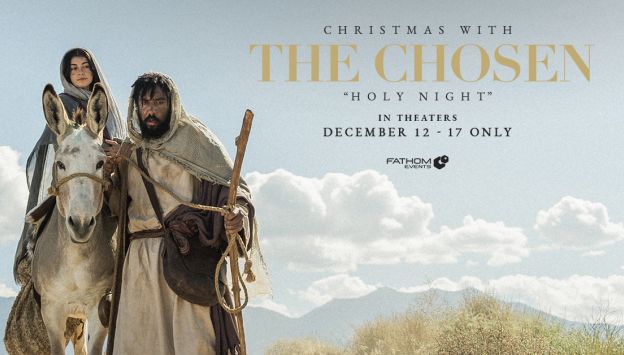
Christmas with The Chosen: A Simple yet Sensational Spiritual Experience

“A young mother labeled impure. A shepherd boy considered ‘unclean.'” This is the summary for the movie event Christmas with The Chosen: Holy Night provided by Fathom Events. I had the privilege of seeing this movie on the big screen this Christmas season. Ever since the nativity of Jesus, there have been over twenty film adaptations (give or take) made to tell their own version of this ancient story. But few of them capture the hope of the season quite like this movie event.

Christmas with The Chosen: Holy Night combines two other movies, The Shepherd (2019) and The Messenger (2021), which were previously made by the same minds behind the popular Biblical drama series The Chosen. The Shepherd , as one can guess based on the title and the summary, tells the story of that famed night through the eyes of one of the shepherd boys. While The Messenger takes viewers on the road to Bethlehem along with Mary and Joseph.

Hurdles and Hope

Both of these movies individually succeed at providing their own separate insights into the story of Jesus’ birth. But together they create a unique story with the overarching theme of hope for those waiting for the Messiah, especially those deemed “unworthy” by society. This is explored through the shepherd boy’s physical deformity. Early in the movie, the shepherd is banned from entering the temple when a cut on his arm begins to bleed excessively. This response is likely based on the grounds of Leviticus 25 which states that those who bleed are considered unclean. Things aren’t much better in his own group as the other shepherds tease him for being slow and force him to bear the brunt of the workload.

This is paralleled by Mary and Joseph’s side of the story. During their journey, Joseph mentions his wife’s “condition” and the uncertainty of her fate when they first heard the news. Since Mary was not yet wed to Joseph, her pregnancy likely sparked rumors among the citizens of Nazareth that she had been unfaithful. In addition to having her name dragged through the mud, she also faced the threat of being stoned to death had it not been for divine intervention. Unfortunately, their troubles didn’t end when they reached Bethlehem. Despite rushing from place to place, none of the inns would take them in. Although it is possible that there were no vacant rooms due to the census, Joseph mentions that they could have been turned away because they didn’t have as much money as the other travelers. Considering how people from lower socioeconomic classes have been treated throughout history, this is a reasonable assumption.

Even in the midst of their trials, the narrative still delivers a sense of hope, emphasized by the performances given by the actors. While, Joseph laments the direness of their situation to his wife, she offers him a smile and says “We’ll make it work.” It’s apparent that Mary trusts that things will turn out well in spite of their unusual circumstances. After a long journey and hours of pain, her patience is rewarded with a child who will grow up to be the Messiah.

The shepherd boy’s journey is a bit slower, but still satisfying. Throughout all of the rejection and teasing, the prophecy he overheard in the temple keeps him going. Ultimately, he too is rewarded in the end with the chance to meet the newborn king and to be accepted in spite of his disability. Although there’s no telling what awaits him back home, he still finds hope in the Savior’s birth and the young couple’s warm welcome. Fans of the classic underdog story will likely get a thrill out of this part of the story.

From Scripture to Picture

Of course, this message could be gained from any textbook, storybook, or even the book of Luke. But what makes this movie unique is how Dallas Jenkins and the actors are able to take these figures we so often read about and turn them into people we encounter in our everyday lives. Nowhere is this more apparent than with Mary and Joseph. Too many people forget that these ancient Biblical figures were once human. Thus, they could make the mistake of taking the roles too seriously and thus losing people’s attention. Thankfully, these two weren’t afraid to be playful and even somewhat silly at times. Throughout the movie, they portray such beautiful, genuine chemistry. So much so that the audience could believe that the actors are a real couple. Their most endearing performance together comes during the birth of Jesus. Without giving too much away, the way they open up to each-other while preparing to meet their son adds an extra layer of emotion to an already touching scene.

With a cast of such memorable and endearing male characters, Mary could have easily been left behind. Thankfully, Jenkins remembered that while so many people label this as “Jesus’ story,” this is also largely hers. The actress is able to deliver an engaging arc with a realistic, authentic performance. One such example can be found later in the film when she is preparing a makeshift cradle for her son. She begins to recite the Magnificat while trying to breathe through her contractions. It’s likely many mothers in the audience could feel and relate to her pain as well as her joy.

Her arc is expanded on by the older version of Mary, played by Vanessa Benavente. During her interactions with Mary Magdalene years later, the audience learns that she was relatively shy when she was younger. But after hearing everyone else share their stories of trials and tribulations, Mary decides that she’s ready to share her story. During this scene, the audience is also treated to some touching exchanges between her and Mary Magdalene. Despite feeling feverish and weak herself, she is still able to provide comfort and reassurance to ease Mary Magdalene’s growing concern. Benavente’s performance bears some similarities to Phillipa Soo’s performance as Eliza Schuyler in Hamilton; strong, compassionate, and resilient. The comparison is rather apt because both characters demonstrate the power of gentle strength for girls and young women in desperate need of strong, female role models.

Joseph’s actor is able to bring his own take on the character while staying true to what makes him so beloved. Though soft-spoken and gentle, he’s able to step up when his wife needs him most. His performance stands out the most once they arrive in Bethlehem. After being turned away from the inn, the audience can hear in Joseph’s voice the inner turmoil between wanting to unload on the innkeeper and staying calm for his wife. It’s a scene that has to be witnessed in order to be fully understood. The actor reaches his peak during the birth scene. When he reminds Mary what the angel said to both of them months ago, “Don’t be afraid,” it’s as though he’s speaking to the audience as well as his wife.

Though he doesn’t appear to have as much purpose or significance as the holy couple, the actor who plays the shepherd boy is able to deliver an unforgettable performance. He’s able to say so much about his character even when he doesn’t utter a word. When he hesitates after being approached by Joseph and flinches when the pharisee passes by, the audience can sense his ever-present fear and shame. His tears and whispers of thanks between sobs pose the question: “Is his reaction only about the Messiah’s arrival? Or could it also be because he’s finally able to connect with others without rejection?” Then there’s his response to Mary’s concern over his injured arm: “It’s fine.” It’s likely that his response resonates with so many audience members who have disabilities, both visible and invisible.

Conclusion

Christmas With The Chosen: Holy Night delivers a unique spin on an ancient story with raw, emotional performances. Although Christmas day has come and gone, the messages of hope and kindness delivered by the movie are ones people should carry into the new year, especially in light of recent circumstances. It’s the perfect feel-good spiritual film for families during the Christmas season and all through the year. After the release of this post, the full movie was released on Amazon Prime. For those who do not have a subscription to Amazon Prime, the full versions are available separately on YouTube. I hope you all have a very blessed Christmas season and a happy New Year. As always, feel free to share your opinions on the movie.

My Struggle with Secondhand Trauma

I’m not sure exactly where to start with this post. This is something that I’ve carried with me for a little over a year and I’ve only recently decided that it’s worth sharing on my blog. After all, this blog is supposed to give you an insight into who I am and that includes my interests, ambitions, strengths, weaknesses, challenges, and even my setbacks. Well, I guess a good place to start would be the very beginning.

Where it All Began

The year was 2020 which, as you know, was an extremely trying year for just about everyone. But for some people, it was loaded with some additional obstacles. In my case, that was my final semester of my Senior year of college. Once you become a Senior, you’re required to do a practicum (kind of like an internship) for your field of study. In my case, that field was social work. So, after many days and weeks and months of searching during my summer break, I finally managed to find an organization where I could fulfill my practicum requirement.

Although it took some getting used to, my practicum started off as an overall positive experience. I learned a lot of valuable information, I met some very kind and hard-working people, and I even reorganized the layout of the food bank. Little did I know something in the next few months would send me hurtling toward rock bottom.

It was a cold Sunday evening in November 2020. I was in the family room preparing for school the next day when my mom came in and informed me that she was going up to Church to light a candle for her friend’s son. That’s when I remembered an unopened prayer request email I had received from the organization where I was doing my practicum. I opened the email to find a message that read something along the lines of: “Prayer request for Iliana Delphine Connelly (name changed) who died before birth.”

As I read on, I realized that the message was referring to the baby daughter of one of the female employees I was closest to. She had served as sort of a mentor figure to me and showed me a substantial amount of patience when I was just starting out.

How do I even begin to describe how hard this news hit me? I could say it was like I had been shot through the heart or like I had fallen into a pit or like my whole world faded to black, but even those would be understatements. Needless to say, I was a total wreck. I could hardly sleep that night and I didn’t even want to write in my journal. Since most of my ideas were about pregnancy or childbirth, I thought it would be disrespectful in light of the circumstances even though they would be safely tucked away in my journal.

Naturally, I didn’t feel like going to my class the next day, but I knew I had to. Although I managed to convince myself to attend class, I had a lot of trouble paying attention. The grief and agony followed me around everywhere like a shadow monster, constantly taunting me with that horrible memory. Thankfully, my teacher understood. When I told her about this during our meeting, she offered me her condolences and told me she understood why I seemed so off during class. She even offered to help me arrange an appointment with the on-campus therapist, but I declined only because I had already decided on a different therapist.

An Emotional Rollercoaster

Ever since that day I’ve had my emotional ups and downs. When I started seeing my therapist, she walked me through a technique called Eye Movement Desensitization and Reprocessing (EMDR.) After seeing her for about a year, I felt much more at-ease and in control of my emotions. Then things got bad again when she went of sabbatical. I tried to see it as an opportunity to implement what we had learned and to take my mental health into my own hands. But then I had two encounters that really knocked me for a loop.

The first was when I was browsing Tumblr for some Hadestown fan art. I found some artwork depicting scenes and characters from a Hadestown fan fiction I found on Archive of Our Own. I won’t reveal the name of the work or the author in order to spare them from any possible harassment. However, I will mention that several chapters involved Hades and Persephone losing a baby. My second encounter was when I looked up the ending to the game Hades where Zagreus, the protagonist, learns that he was a stillborn and Persephone, his biological mother, became so overcome with grief that she couldn’t take life in the underworld and left as a result. Not helping is that the player apparently has to beat the game multiple times thus forcing Persephone to re-live her trauma by witnessing her son die again and again.

See, I usually turn to musicals and Greek myths for comfort during difficult or stressful times. While they obviously aren’t immune to darker themes, I hadn’t encountered any themes that had reminded me of such a personal tragedy. That’s when a million different questions started running through my head, such as: If Hades and Persephone are immortal, wouldn’t their children be immortal by extension? Several of the myths have shown that gods are good at surviving extreme circumstances even before birth. So, how is it even possible for a goddess to lose a baby? How could the fates possibly have any control over the other gods? If it’s possible for a goddess to lose a baby, why hasn’t this happened to any of the other goddesses? If this universe establishes that there is a life after death, why do they act like the baby is gone, gone? Why is this such a common plotline for Hades and Persephone, when there are a myriad of other conflicts and plotlines that could be used?

It didn’t help that I was already going through a lot in my personal life. I was undergoing a considerable amount of stress at my job and I didn’t exactly see eye-to-eye with one of the teachers I was assisting. In addition to this, my parents were trying to get my brother into treatment for substance abuse problems. I didn’t even have the support of my therapist because I eventually found out she wouldn’t be returning to her practice due to some vague health problems.

I would have days or even weeks with little to no anxiety, but then those bad feeling would creep up on me again after some time. It was a continuous pattern that I desperately wanted to escape.

Growth and Healing

At first, I tried to blame the artists who made and posted the upsetting content. That’s not to say I contacted them directly or made any posts bashing them or their work. However, I would vent to my mom and my sister about how little care and consideration they showed by choosing to implement such themes in such a fantastical setting.

When I realized that wasn’t making me feel better, I started blaming myself. I wondered why I couldn’t just feel sad for a little while and then move on like normal people. I didn’t think I had a right to be this upset since this situation didn’t happen to me directly and the woman it did affect wasn’t even part of my biological family. I felt so silly for getting so upset over such lovely fan art that didn’t directly reference or depict anything related to my trauma.

Since it was all in my head, I decided to take matters into my own hands by searching for ways to cope with my anxiety online. Most of the suggestions I found only worked briefly, if at all. I started to feel broken and helpless. Every day I would hope by some miracle that I would be able to rise above it permanently or that I would wake up and my anxiety would be gone forever, or at least stop pestering me unnecessarily.

Eventually, things started to look up for me. After a few less than satisfactory sessions with one therapist, I decided to start over with a different one. When I opened up to her about what I was going through, she revealed to me that I was being triggered. Finally I had a name for that tight sensation in my throat and that sick feeling in my stomach. I realized it was okay to say that I was dealing with trauma.

Now that I had put a name to my feelings, the next step was to figure out how to control them. The first solution came to me when I went back to a fan fiction I hadn’t worked on for over a month. At first, I had trouble focusing and I couldn’t find the right words. But after giving it a few more minutes, the words came to me and my fingers started flying around the keyboard. That’s when I decided not to worry about what everyone else was doing and to just focus on writing what I wanted to see. That meant no more browsing social media, especially Tumblr, for Hadestown fan art or fan fictions except the ones I had seen before and knew could be trusted.

The second solution came from an old book I found lying around my parents’ house. When I opened it, I found a page that said when you feel scared “Put your imagination to work calming you down. Close your eyes and visualize a bright, cheery place. In your mind, rerun a ‘film’ of something pleasant that happened recently or create one about something fun coming up in your life.” Of course, sometimes my negative thoughts interrupt my positive ones. When that happens, I repeat these these words to myself: “I am safe. I am strong. I am loved.” After taking a few deep breaths, I put on another movie.

I also found a lot of solace in my Catholic Faith. Every Friday morning I would go up to Church and join my mother during her hour of adoration. This gave me time to meditate and reflect on my feelings. I could talk to my God about whatever was on my mind and even if I couldn’t see or hear Him, I knew He was listening. This made me realize that perhaps my anxiety isn’t entirely about what happened to my mentor. More often than not, I’m actually overwhelmed with the hustle and bustle of everyday life. Sometimes I need to just slow down and reflect on what truly matters to me: Jesus Christ, my Lord and Savior.

Finally, I decided to face my past head-on. I searched the website of the place where I completed my practicum. There I found an article stating that my old mentor figure had successfully delivered two, healthy twin girls on November 24th, 2021. After a little over a year of trying to avoid having anything to do with the organization to try and dodge the painful memories, I decided enough was enough. I made and sent a card to her, expressing my most sincere congratulations. Even though I haven’t seen or spoken to her, I knew I had done the right thing by trying to get in touch with her and sending her a message that would make her day.

Conclusion

The death of my mentor’s baby is definitely not something I would like to go through again. Still, this experience has taught me a lot. I realized that trying to blame anyone, even myself, was counterproductive because no one is at fault. Sometimes things just happen that we aren’t prepared for and everyone responds to a crisis differently. I have also learned that my thoughts aren’t always going to be rational because anxiety is often irrational like other feelings and feelings come and go. Besides, my fear stemmed from empathy and sorrow for someone I cared about. That means I have a big heart and I’m not afraid wear it on my sleeve. So instead of trying to bully myself out of anxiety, I just need to live with it. Finally, I learned to be good to myself, not just when I feel anxious but all the time. I can do so by avoiding situations that trigger me when I can and rewiring my thoughts when I can’t avoid my triggers.

If all of this is a bit too wordy or overwhelming, just remember this quote from a beloved Disney film: “The past can hurt. But the way I see it, you can either run from it or learn from it.”

6/25/2021: A Spiritual Experience

This morning my mom and I went to Church for her weekly adoration hour. I used to find Church rather boring when I was younger. But now I find that I can appreciate the quiet atmosphere. Sometimes I just need to take a break from the chaotic noise life brings me and just spend some time with God. Still, I sometimes have a hard time focusing on what I need to do or what I want to say. Sometimes I don’t even know where to start because I have so much on my mind. Other times it’s because my mind is completely blank. But I’ve found ways to manage these hiccups.

Sometimes I like to bring my prayer journal with me. I often have an easier time organizing my thoughts when I write them down. I’ve also found myself more able to focus on my writing than doing other tasks. On the occasions when I don’t have my journal, I simply talk to God about whatever it is that’s on my mind. Even if it’s about something that might seem silly or unimportant, like my fan fiction ideas or a certain song I can’t get out of my head, I tell Him everything. I just have to remind myself that every prayer, big or small, serious or fun, ordinary or extraordinary; matters.

Even then, sometimes I find myself at a loss for words. When that happens, I take the advice given to me during a worship I attended at college. I sit quietly and I listen. At first, I was confused. How am I supposed to listen when I can’t hear anyone speak to me? But the more I thought about it, the more I understood. See, our lives are often so filled with noise that we rarely find time to stop and think. The quiet time in prayer allows me to look into myself and the world around me for clues as to what God is trying to tell me. These clues help me reflect on who am as a woman, as a citizen, and as a daughter of Christ.

Now, I didn’t make this post just to preach or to force my beliefs down your throat. What I’m trying to say is that my faith brings me a sense of comfort. Since I tend to get overwhelmed by loud noises or too many noises happening all at once, it’s nice to have a place where I can just get away from it all. I also like having someone or something I can turn to when all my other resources fail me.

That’s all I really have for today. Maybe I should try and implement some more quiet time into my schedule during the week. It might give me the motivation and focus I need to complete some of my other projects.